 Skip-the-line available
 Strahov Library vs the Klementinum
Prague has two celebrated Baroque libraries. Here's how Strahov and the Klementinum actually differ — location, history, architecture and how you visit each.
Prague has not one but two famous Baroque library halls, and visitors sometimes assume they're the same place. They aren't. Strahov and the Klementinum sit in different parts of the city, belong to different institutions, and grew out of different histories — here's how they compare.
Two different institutions, two different parts of Prague
Strahov Library and the Klementinum are Prague's two best-known Baroque library halls, and it's an easy mix-up for first-time visitors, since both involve gilded ceilings, painted frescoes and rooms full of old books. They are not the same place, however, and sit on opposite sides of the city's historic core. Strahov is part of a working Premonstratensian abbey on the Hradčany ridge, west of Prague Castle, still home to a monastic community and its own church, brewery and courtyard. The Klementinum, by contrast, occupies a vast former Jesuit college in the Old Town, close to Charles Bridge, and today houses the Czech National Library rather than a religious community. One is a monastery you can visit; the other is a national library that happens to have a spectacular historic reading hall. Despite sitting in different districts, both complexes are large enough to feel like small self-contained worlds once you're inside them — Strahov with its abbey church, brewery and terrace around the library, the Klementinum with its courtyards, chapels and the tower rising above the rooftops of the Old Town. Neither is a single-room stop, and both reward treating the library hall as one part of a larger visit rather than the whole of it. First-time visitors planning a Prague trip around historic libraries sometimes assume they can simply pick 'the library tour' without realising there are two entirely separate bookings, addresses and, in the Klementinum's case, timed-entry systems to navigate — a mix-up worth avoiding before you're standing at the wrong gate.
Founding and history
The two institutions grew from very different roots. Strahov dates to 1143, founded as a Premonstratensian abbey for canons regular who combined prayer with pastoral and scholarly work; its library has been rebuilt more than once after wars and confiscations, most recently in the Baroque period. The Klementinum began much later, as a Jesuit college established in 1556, part of the Counter-Reformation push to re-establish Catholic education in Bohemia. Over the following two centuries the Jesuits expanded it into one of the largest building complexes in Prague, with the main Baroque construction running from about 1709 to 1726. When the Jesuit order was suppressed across Catholic Europe in 1773, the Klementinum's library and collections passed into state and university hands, eventually becoming the core of today's Czech National Library — a very different afterlife from Strahov, which remains under the same religious order that founded it. The difference in institutional fate also shows in how each site is run today. Strahov remains under the direct care of the Premonstratensian community that has occupied it, on and off, since 1143, which gives the visit something of the character of stepping into a still-functioning religious house. The Klementinum's National Library administration, by contrast, runs the site more as a cultural and heritage attraction layered onto an active research library, with the historic rooms largely separate from the library's modern working collections held elsewhere in the building. Strahov's centuries of disruption and rebuilding, covered in full in our dedicated history guide, also mean its current halls are more recent in construction than many visitors assume, despite the abbey's much older founding date — a contrast worth keeping in mind when comparing the two sites' architecture rather than simply their founding dates.
The library halls themselves
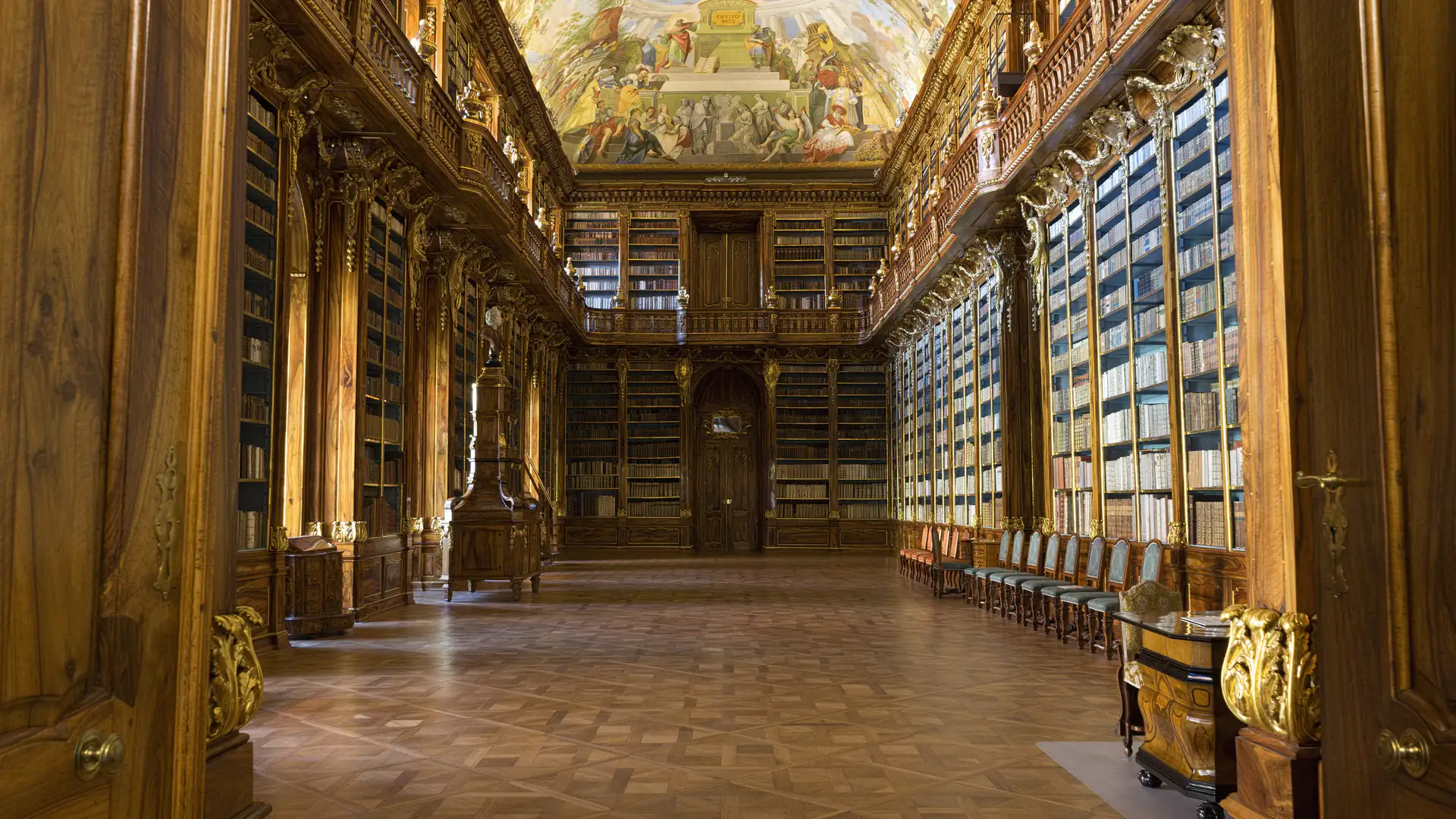
Architecturally, the two sites take different approaches. Strahov has two separate halls built a century apart: the Theological Hall, completed in 1679 to designs by Giovanni Domenico Orsi with ceiling frescoes added in the 1720s by the monk-painter Siard Nosecký, and the larger Philosophical Hall, built in the 1780s and crowned in 1794 by Franz Anton Maulbertsch's fresco The Intellectual Progress of Mankind, above walnut bookcases brought from a dissolved sister monastery in Moravia. The Klementinum's Baroque Library Hall is a single grand room, built in 1722 to designs by Kilián Ignác Dientzenhofer and decorated with ceiling frescoes on the theme of science and art by the painter Jan Hiebl. Alongside its library hall, the Klementinum also has a landmark Strahov doesn't: the Astronomical Tower, completed the same year, rising 68 metres above the complex. Both architects were prominent figures of their moment in Baroque Prague, and comparing their work side by side is part of what makes visiting both libraries rewarding for anyone interested in the period. Orsi's Theological Hall and Dientzenhofer's Klementinum Library Hall are separated by little more than four decades, yet each reflects a slightly different stage of Bohemian Baroque design, from Orsi's more restrained stucco work to Dientzenhofer's fuller embrace of illusionistic ceiling painting. Both rooms remain functioning parts of their respective institutions rather than static museum reconstructions, which is part of why conservators at each site are so protective of the floor access visitors are given.
What each ticket lets you see
What you actually see on each ticket differs too. At Strahov, the regular ticket takes in the library exhibition and the Cabinet of Curiosities up close, with the Theological and Philosophical Halls themselves viewed from their entrance doorways to protect the books; a Joint Tour option adds the Strahov Picture Gallery and historic abbey rooms. At the Klementinum, the Baroque Library Hall is likewise viewed rather than entered on the standard visit, but the headline visit there is different: a guided route that includes a climb of the Astronomical Tower — 172 steps to a circular viewing balcony — for one of the best panoramic views over Prague's Old Town rooftops. Where a Strahov visit centres on the library halls themselves, a Klementinum visit is built as much around the tower climb as the library room. Neither site allows visitors to walk the floor of its main library hall, so the sense of viewing from a fixed vantage point rather than wandering freely is common to both — it's a shared feature of how historic libraries with fragile collections manage public access, not a quirk unique to either site. Where they diverge most is in what surrounds that core library visit: Strahov's Cabinet of Curiosities and picture gallery on one side, the Klementinum's tower climb and panoramic city view on the other.
Which one should you visit
Neither library beats the other in any simple sense — they reward different things. Strahov suits visitors already spending time around Prague Castle and Hradčany, who want a monastery library with real architectural depth (two halls, not one) and a stranger sideline in the Cabinet of Curiosities, all inside a complex that still functions as an abbey. The Klementinum suits visitors based in or near the Old Town who want a single striking library hall paired with a genuine viewpoint over the city from the Astronomical Tower — worth it for the climb alone, quite apart from the library. If your schedule allows it, the two make a good full day of Baroque Prague between them, on opposite sides of the river; if you only have time for one, let your base and your itinerary — Hradčany or the Old Town — decide rather than any real gap in quality between them. If you're travelling with children, the Klementinum's tower climb often has more built-in appeal — stairs and a view to reach are an easier sell than a library hall alone — while Strahov's Cabinet of Curiosities, with its stranger objects, tends to hold younger visitors' attention in a similar way. Either site works well as a family stop, just for slightly different reasons. History-minded visitors with a specific interest in monastic life, rather than Baroque architecture in general, will likely find Strahov the more satisfying of the two, simply because it remains a functioning religious community rather than a library hall preserved inside a secular institution. Visitors chiefly drawn by photography and viewpoints, on the other hand, tend to rate the Klementinum higher, purely because the Astronomical Tower gives a payoff — a genuine panoramic view — that Strahov's library visit, focused inward on two rooms, doesn't attempt to offer.
Practical differences for booking and visiting
Booking the two sites works a little differently in practice, beyond simply their content. Strahov's Library ticket and Joint Tour are both entry by date rather than a fixed time slot, so once you've chosen a day you can arrive at any point within opening hours and still be admitted, right up to the last-entry cut-off. The Klementinum's tower-and-library tour, by contrast, typically runs as a guided visit at set intervals through the day, since the Astronomical Tower's stairwell can only hold a limited number of people at once — so a Klementinum visit usually means working around a particular time window rather than an open date.
That difference is worth factoring into your itinerary. A Strahov visit slots flexibly around whatever else you're doing in Hradčany that day, while a Klementinum visit benefits from being planned with a specific time in mind, ideally worked out before you commit to the rest of your day's plan. Neither approach is better outright — the flexible model suits an add-on stop, the timed model suits a visit you want to build part of the day around — but knowing the difference in advance avoids a wasted trip to either site expecting the other's system.
Physically, the two visits also demand different things of you. Strahov's library visit is entirely level, gentle walking through the exhibition, the halls' doorways and the Cabinet of Curiosities. The Klementinum's Astronomical Tower climb, meanwhile, involves 172 steps in a historic stairwell with no lift, which is worth knowing if stairs are a concern for anyone in your group — the library hall portion alone is a much gentler option there too, if the tower itself doesn't appeal.
Both sites are best booked with a specific date, and in the Klementinum's case a specific time, chosen in advance rather than decided on the day, since both are popular stops on any Prague itinerary that includes their respective neighbourhoods.
One more practical note: because the two sites are genuinely separate attractions with separate tickets, a ticket to one does not grant any access to the other, and there's no combined pass covering both. If a full day of Baroque Prague libraries appeals, budget for two separate bookings rather than assuming one purchase covers the pair.
Frequently asked
Are Strahov Library and the Klementinum the same place?
No — they're two separate Baroque libraries in different districts of Prague, run by different institutions.
Which is older?
Strahov Monastery was founded in 1143; the Klementinum grew out of a Jesuit college established in 1556. Both libraries' current Baroque halls date from the 17th and 18th centuries.
Can I visit both in one day?
Yes, with planning — they're on opposite sides of the historic centre, roughly a 20 to 30 minute walk or a short tram or metro ride apart.
Which has the astronomical tower?
The Klementinum. Its Astronomical Tower, completed in 1722, can be climbed for panoramic views; Strahov does not have an equivalent tower open to visitors.