 Skip-the-line available
 What to See Inside Strahov Library
A room-by-room look at the Theological Hall, the Philosophical Hall and the Cabinet of Curiosities — and exactly how close you get to each.
A Strahov Library visit moves through three distinct stops in a small footprint: the library exhibition, the Cabinet of Curiosities, and the doorway views into two Baroque halls. Here's what's in each, and what you can and can't get close to.
The library exhibition
Before you reach either of the two famous halls, the visit opens with a library exhibition — a walk-through room of display cases holding a rotating selection of Strahov's own historic books and facsimiles of its most valuable manuscripts, alongside panels explaining the collection's history. Unlike the halls themselves, this part of the visit is designed for close viewing: you can lean in over the cases and take your time with individual volumes, bindings and illuminated pages in a way the Theological and Philosophical Halls don't allow.
It's worth treating the exhibition as more than a corridor to the halls. The context it gives — how the collection was built, lost and rebuilt, what a given manuscript or binding technique tells you about its period — makes the doorway views that follow considerably more meaningful, especially if you don't already know the story of the 1648 looting or the 1780s rebuilding. Panels throughout the exhibition are written for a general audience rather than specialists, giving enough context on the abbey's history — the 1648 looting, the two rebuilding campaigns — that the two halls make more sense once you reach them. It's also where you get the clearest sense of just how large the wider collection is: 200,000 volumes is an abstract number until you see a handful of individual bindings, tooled leather covers and hand-lettered spines up close, each one part of a whole that dwarfs what any single case can show. Signage is in Czech and English throughout, so international visitors don't need a guide or an audio device to follow the story the exhibition tells, though the guided visit our concierge team can arrange goes considerably deeper for anyone who wants it.
The Theological Hall, through the doorway
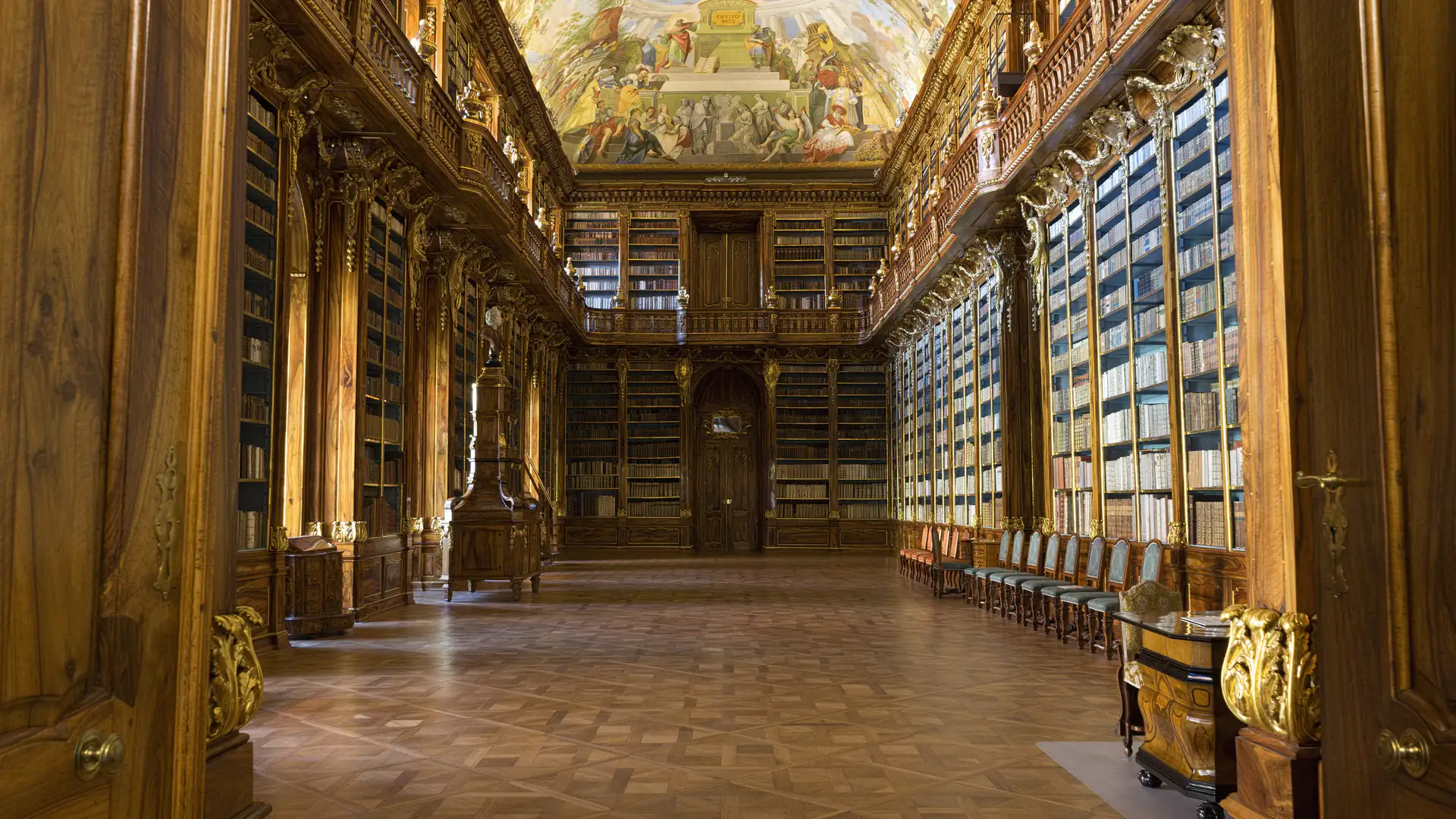
The first of the two halls is the Theological Hall, built between 1671 and 1679 and viewed from its entrance doorway rather than entered. What you see from there is still substantial: a long room lined on both sides with around 18,000 theological volumes behind gilded stucco frames, the shelving rising close to a ceiling entirely covered in fresco. Siard Nosecký, a monk of the abbey, painted that ceiling in the 1720s on the theme of true wisdom, and from the doorway the whole composition is visible in a single glance in a way it wouldn't necessarily be from directly underneath.
Look for the pair of large globes standing at either end of the hall — one celestial, one terrestrial, made in the Dutch Republic in the 17th century. Their painted surfaces record constellations and coastlines as European mapmakers understood them at the time, complete with the guesses and gaps later exploration would correct. From the doorway they read as two dark, weighty punctuation marks at either end of a room otherwise dominated by gold and warm wood. Take a moment at the doorway simply to let your eyes adjust and travel the length of the room before picking out detail. The gilded stucco framing each shelf catches available light differently depending on the time of day and the season, so the hall can look noticeably warmer in the low light of a winter morning than under the brighter midday sun of summer. Photographers in particular find the doorway angle rewarding once they've accepted they won't be walking the floor — the symmetry of the room, with its matched globes and even rows of spines, composes well from a fixed vantage point in a way a closer, wandering view often doesn't.
The Philosophical Hall, through the doorway
The second hall, and for most visitors the highlight of the visit, is the Philosophical Hall — 32 metres long, 10 metres wide and 14 metres high, considerably larger than the Theological Hall. Its two-storey walnut bookcases weren't built for this room at all: they were carved for Louka Convent in Moravia and brought to Prague when that monastery was dissolved in the 1780s, giving the hall a slightly patched-together history that isn't obvious from the doorway but adds real depth once you know it.
What dominates the view, though, is the ceiling. In 1794 the Viennese painter Franz Anton Maulbertsch and a single assistant covered the whole vault with The Intellectual Progress of Mankind in about six months — a single sweeping fresco carrying figures from Moses, Adam and Eve through Solomon and Socrates to Alexander the Great and Saint Paul preaching at Athens. From the doorway, the hall's full 32-metre length lines up almost like a telescope, giving a clear view down the entire room and up into the fresco's central scenes, even without walking the floor. Give your eyes time to work through the fresco methodically rather than trying to take in the whole ceiling at once — start near the doorway end and let your gaze travel the room's length, picking out individual figures as they resolve out of the crowd of bodies and cloud. Even without formal art training, most visitors can pick out at least a handful of the biblical and classical figures once they know roughly where to look, and the effort of finding them is part of what makes the hall memorable rather than simply impressive.
The Cabinet of Curiosities
Tucked alongside the two grand halls, the Cabinet of Curiosities is a smaller, stranger stop — and one you view up close, in cases, rather than from a doorway. Bought by the abbey in 1798 from the heirs of a local collector, it belongs to the old European tradition of the Wunderkammer, assembled at a time when natural history, folklore and showmanship still shared the same shelf.
Inside are fabricated 'basilisks' pieced together from parts of real animals, so-called toadstones once believed to cure poison, wax models of exotic fruit, and old weapons and five iron cannonballs dated 1742. It rewards slower looking than the halls do — there's no doorway distance to contend with, just a room of small, odd objects worth reading the labels on rather than walking past. Because this room doesn't have the doorway restriction the two halls do, it's worth taking your time here rather than treating it as a quick stop on the way out. Compare the fabricated 'basilisks' with the genuine toadstones and cannonballs nearby — spotting which items are real and which are constructed is part of the fun. It's also a useful contrast to the two grand halls: where they impress with scale and decoration, the Cabinet of Curiosities works on a much smaller, stranger register, and many visitors end up remembering it as vividly as the frescoes. Cases are arranged loosely by type rather than strictly chronologically, so it rewards browsing rather than reading start to finish in order — dip in wherever an object catches your eye.
Why you view the halls from the doorway
It's worth being upfront about this before you book: the regular ticket does not let you walk into either the Theological Hall or the Philosophical Hall. Both rooms hold books and frescoes that are centuries old and irreplaceable, and opening the floor to daily foot traffic, dust and humidity from visitors would accelerate exactly the kind of decay conservators spend their careers preventing. Viewing from the doorway is how the monastery balances public access against protecting a collection that has already been rebuilt from near-total loss more than once in its history.
In practice, the restriction costs you less than it might sound. Both halls are compact enough that the doorway view takes in the whole room — shelving, globes or bookcases, and the full ceiling fresco — without anything hidden behind a pillar or out of sight. There's no fixed time limit at the doorway either, so unlike some other sights where a guide moves you along quickly, you can stand and take in the detail on your own schedule before continuing to the next stop on the visit. It's worth remembering, too, that the doorway arrangement isn't unique to Strahov — other historic libraries with comparably fragile collections use a similar approach for exactly the same conservation reasons. Framing it as a shared standard rather than a Strahov-specific limitation can make the restriction easier to accept: you're seeing these rooms much the way most visitors to any comparably fragile historic library do, not missing out on an access other travellers are getting elsewhere.
A suggested order for your visit
There's no single mandatory route through Strahov Library, but most visits follow a similar shape. Start with the library exhibition, since the historical context it gives makes the two halls that follow considerably more meaningful — knowing about the 1648 looting before you reach the Theological Hall, for instance, changes how you read a room that would otherwise just look impressively old.
From there, most visits take in the Theological Hall, followed by the Cabinet of Curiosities, and finish at the Philosophical Hall, which many visitors find the more striking of the two and prefer to end on rather than see first. That said, there's no penalty for going in a different order if the layout on the day suggests otherwise, or if you'd rather see the Philosophical Hall's fresco with fresh eyes at the start of the visit instead of the end.
If you've booked the Joint Tour, the Strahov Picture Gallery and the historic abbey rooms typically come as a separate leg of the visit, either before or after the library halls depending on how the day's routing works, so build in the extra 45 minutes to an hour that ticket requires on top of the library portion.
However you sequence it, resist the urge to rush toward the Philosophical Hall as the single highlight and skip past the rest. The Theological Hall's globes, the Cabinet of Curiosities' stranger objects and the context in the library exhibition all add up to a fuller picture of Strahov than the fresco alone, and the whole visit rarely takes more than 45 minutes even at an unhurried pace — there's little to gain from hurrying through the earlier stops to reach the end sooner.
Families with children often find it easier to lead with the Cabinet of Curiosities, since its smaller, stranger objects tend to hold younger attention better than either hall's architecture at first, before moving on to the Theological and Philosophical Halls once curiosity has been satisfied rather than saved for last.
Frequently asked
Can I walk through the library halls?
No — the Theological and Philosophical Halls are viewed from their doorways on the regular ticket, to protect the books and frescoes. The library exhibition and Cabinet of Curiosities are viewed up close.
What's the difference between the exhibition and the halls?
The exhibition and Cabinet of Curiosities are walk-through rooms with display cases; the two named halls (Theological and Philosophical) are viewed only from their entrance doorways.
Can I see the Maulbertsch fresco properly from the doorway?
Yes — the Philosophical Hall's doorway gives a clear line down its full 32-metre length, and the fresco covers the whole ceiling, so very little is lost from that vantage point.
What historic books are on display?
A changing selection of the library's own volumes and facsimiles of its most valuable manuscripts, shown in cases in the exhibition rooms alongside context on the collection's history.