Strahov LibraryPrague, Czechia

Royal Canonry of Strahov

Look into Prague's two Baroque library halls

Gold leaf and painted ceilings glow over hand-bound volumes in two Baroque halls that still smell of leather and old paper. A working library since 1143, looted, rebuilt and quietly added to ever since.

Check availability From €20

Open-date entry — pick the day at checkout, not now.

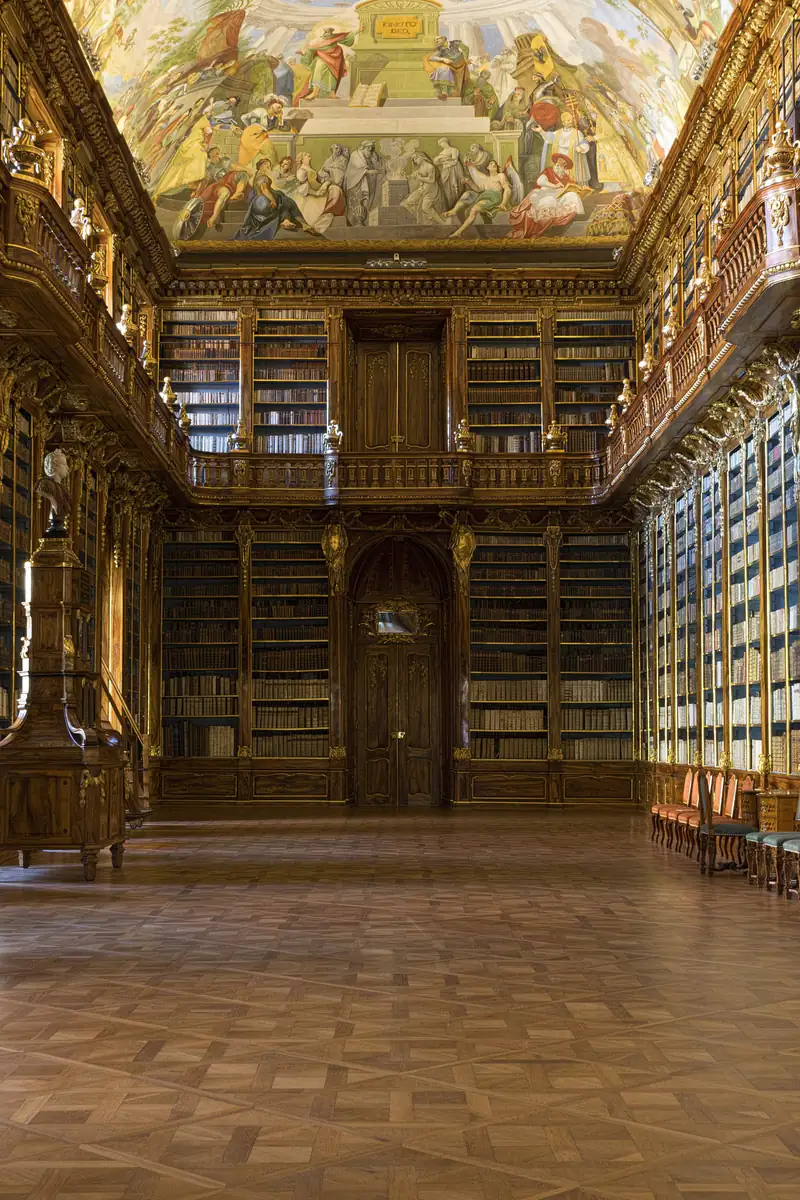
The full length of the Philosophical Hall at Strahov Library, two-storey walnut bookcases lining both walls beneath the painted ceiling fresco, seen down the parquet floor from the entrance end
The Philosophical Hall and its 1794 ceiling fresco

At the threshold

Two ways to see Strahov

Both routes open onto the same two frescoed halls — choose how much of the monastery comes with them.

  • Both Baroque hallsThe Theological and Philosophical Halls, viewed from their doorways
  • The Cabinet of CuriositiesIncluded on every ticket, alongside the library exhibition
  • One simple ticketBooked for your date, delivered by email
Most booked

The Library

You view the hall from its threshold; the floor stays reserved for the books.

AdultAges 18–64 €20pp Notify me
Senior 65+Ages 65 and over (photo ID at entry) €12pp Notify me
StudentStudents under 26 with a valid ISIC card €12pp Notify me
Child 6–17Ages 6–17 (under 6 enter free — no ticket needed) €12pp Notify me

Includes

  • Entry to the Strahov Library exhibition, the Cabinet of Curiosities and a selection of historic books
  • Booked for your chosen date, emailed to you
  • Concierge support in your language before and on the day

Library, Gallery & Monastery

You view the hall from its threshold; the floor stays reserved for the books.

AdultAges 18–64 €30pp Notify me
Senior 65+Ages 65 and over (photo ID at entry) €19pp Notify me
StudentStudents under 26 with a valid ISIC card €19pp Notify me
Child 6–17Ages 6–17 (under 6 enter free — no ticket needed) €19pp Notify me

Includes

  • Entry to the Strahov Picture Gallery, the abbey's collection of Gothic to Baroque paintings
  • Access to the historic parts of the monastery open to visitors (the abbey church is not included)
  • Booked for your chosen date, emailed to you

Online entry runs to a few hundred tickets a day, and you see both halls from their doorways — the floor is kept for the books.

Full refund if the operator cancels

Every cent back if your visit can't be honoured

Cards & Apple Pay

17 currencies · Apple Pay · Google Pay · all major cards

E-ticket by email

Your dated ticket lands in your inbox, ready for your phone

Concierge in your language, 24/7

Real humans on call, even on visit day

  1. 1143Founded as a Premonstratensian abbey
  2. 200,000+Volumes across the historic library
  3. 32 mLength of the Philosophical Hall
  4. 10,000+Travellers helped worldwide

Six views

Inside the halls, and beyond them

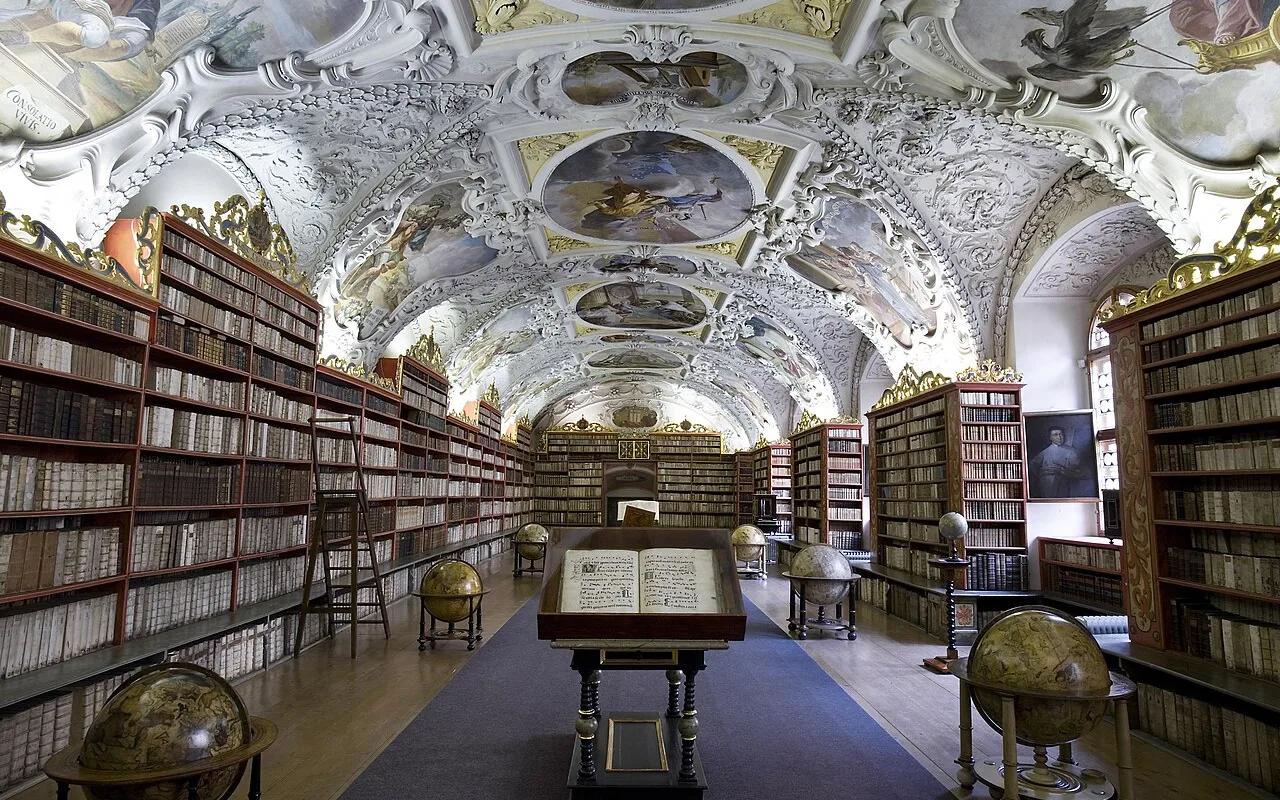
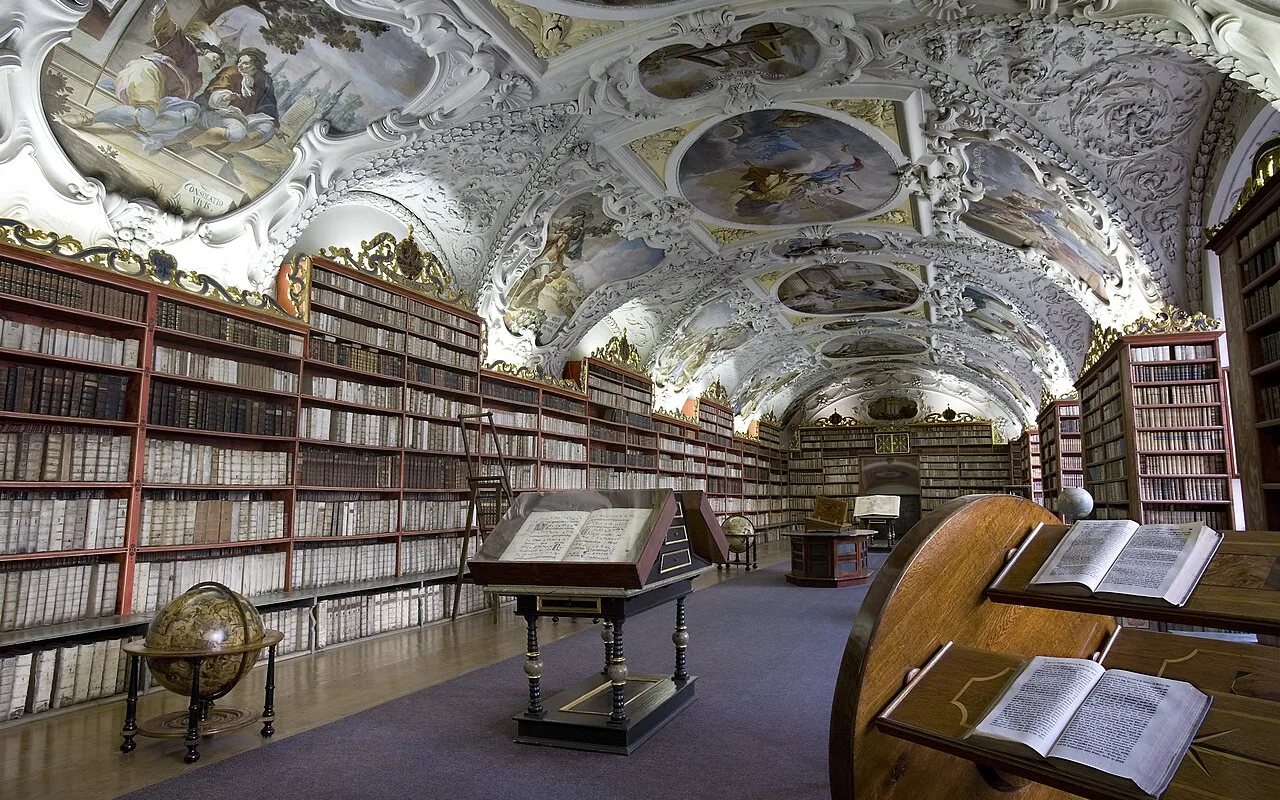
  • The Theological Hall at Strahov Library, gilded stucco bookcases lining both walls beneath a painted ceiling, seen from the entrance doorway The Theological Hall, built 1671–1679
  • One of the pair of 17th-century Dutch celestial and terrestrial globes standing in the Theological Hall 17th-century Dutch globes
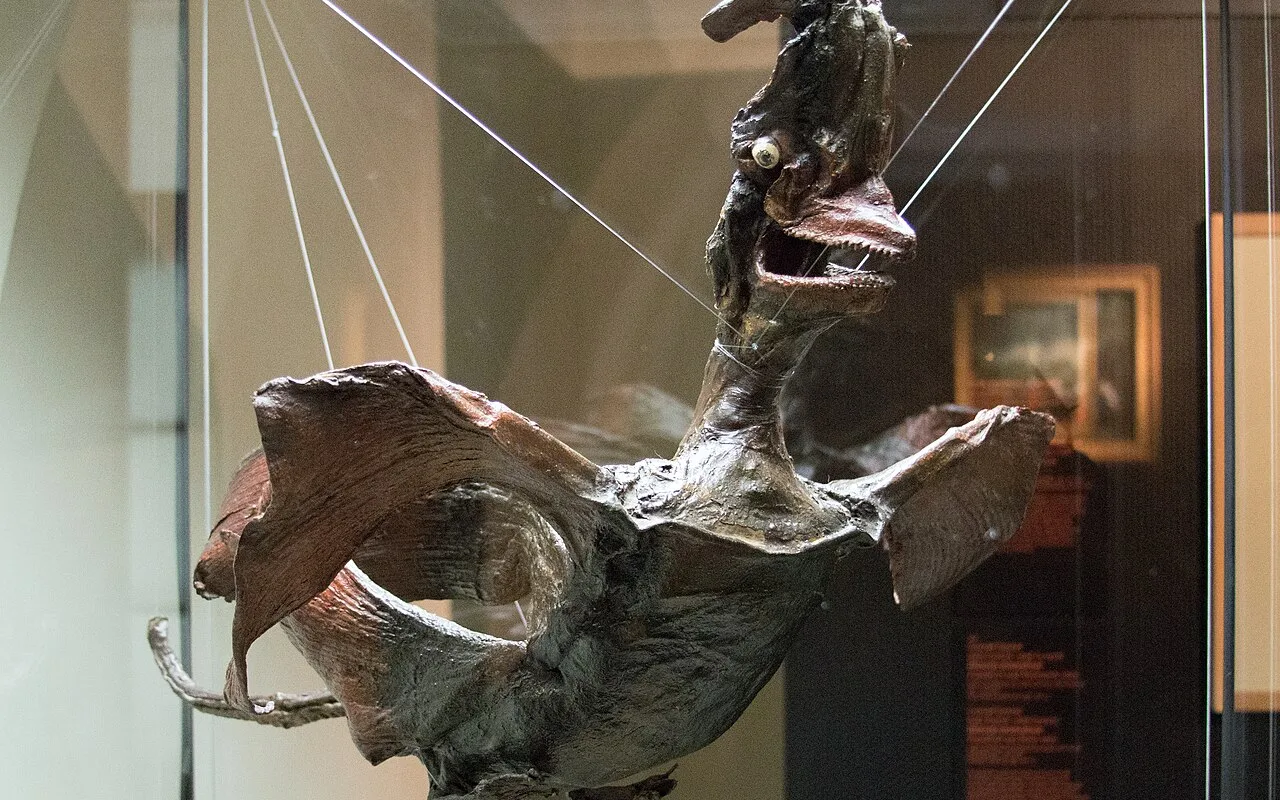
  • A dragon figure made from a thornback ray in the Cabinet of Curiosities, part of the collection the abbey bought in 1798 The Cabinet of Curiosities
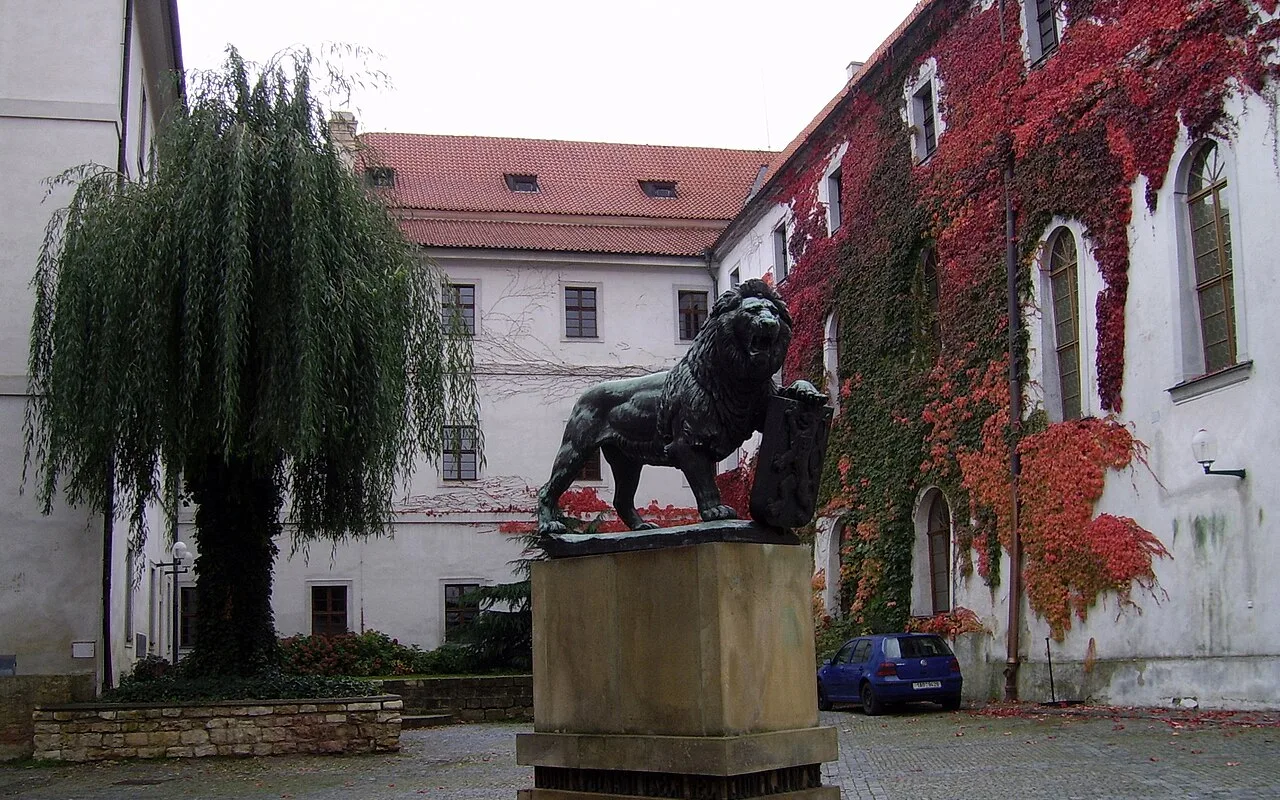
  • A lion statue in the courtyard of Strahov Monastery, with the abbey buildings behind The monastery courtyard
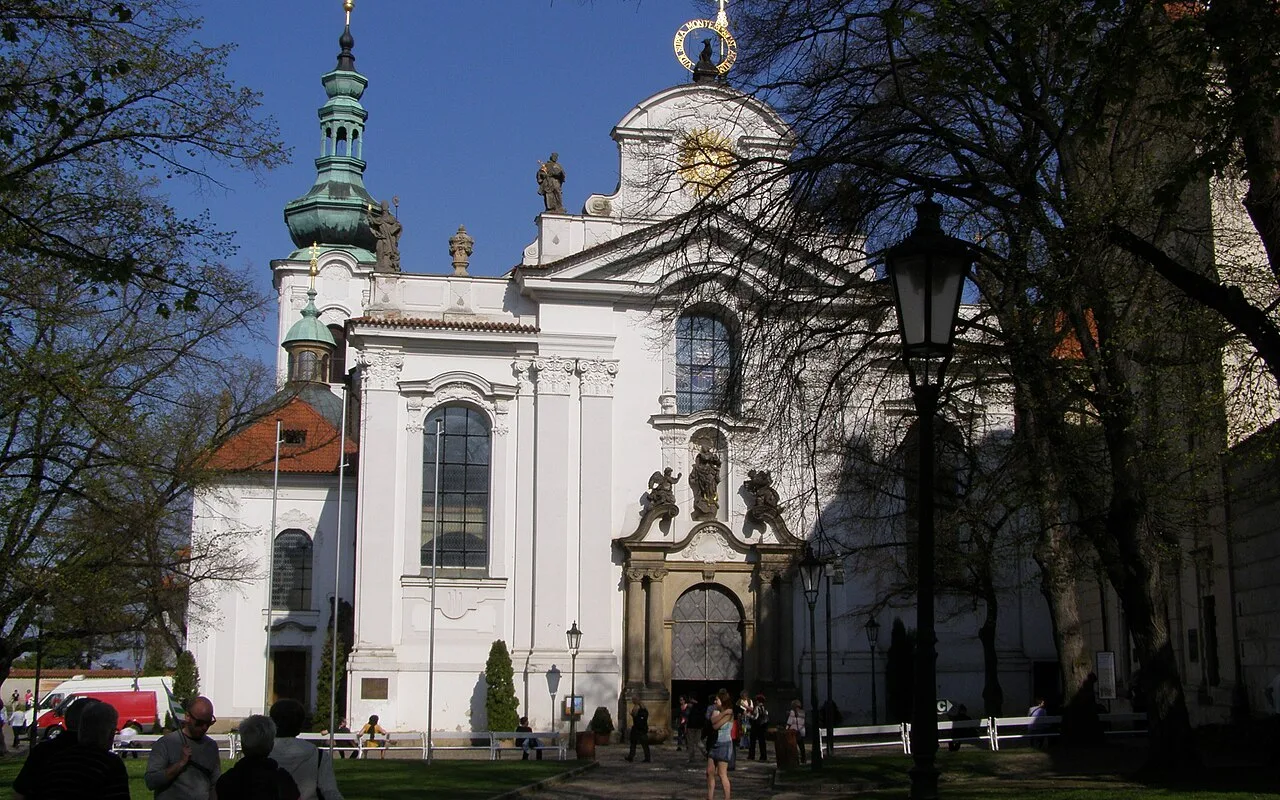
  • The Basilica of the Assumption of Our Lady at Strahov Monastery, seen from the courtyard The abbey basilica
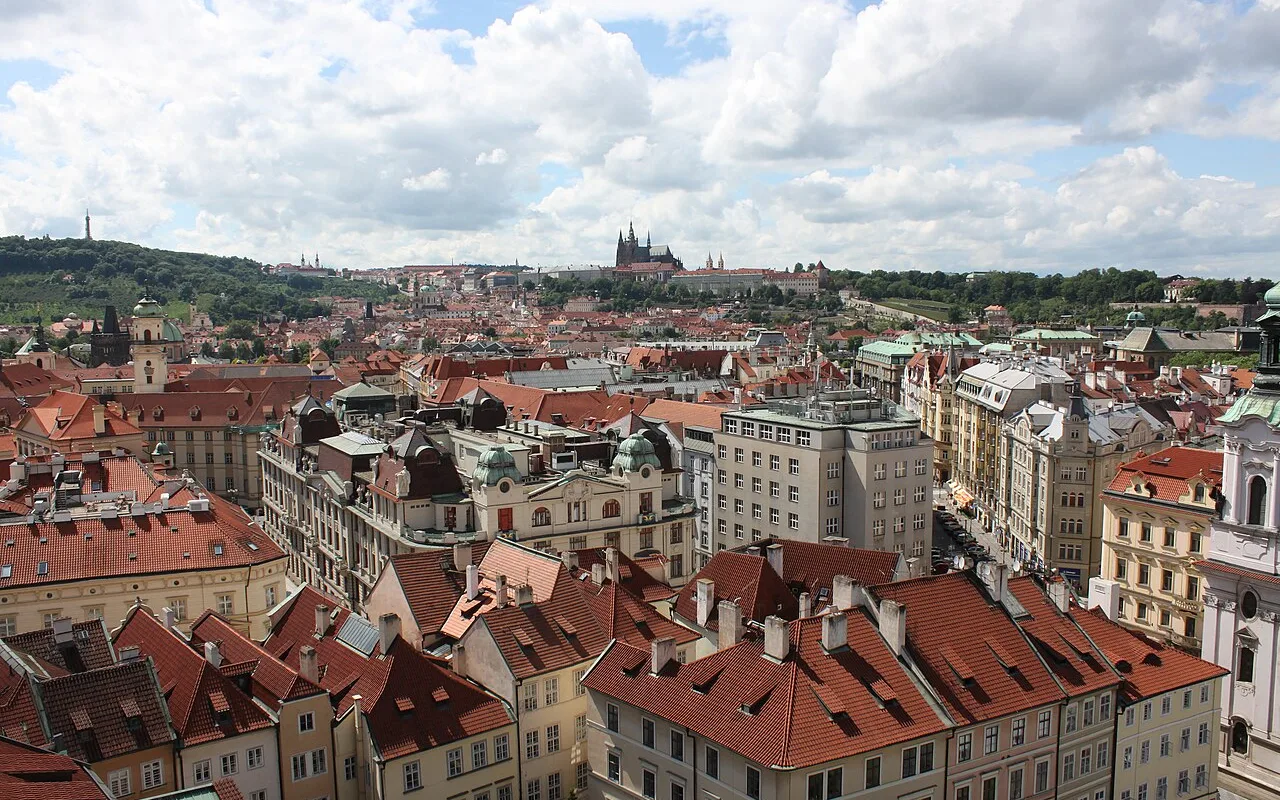
  • Prague Castle and the Hradčany skyline seen from a clocktower The Hradčany ridge

The full record

Nine centuries, section by section

What is Strahov Library?Read

Strahov Library is the working library of the Royal Canonry of Strahov, a Premonstratensian abbey founded in 1143 on the ridge between Prague Castle and Petřín Hill. Premonstratensian canons have kept a community here for most of the nine centuries since, and the library remains part of a working monastery rather than a museum built for the purpose.

What draws visitors to Strahov Library is not the abbey church but two Baroque halls behind it — the Theological Hall and the Philosophical Hall — holding around 200,000 volumes, including roughly 3,000 manuscripts and 1,500 early printed books, under two of the most heavily painted library ceilings in Prague.

A short history: Swedish looting and rebuildingRead

Strahov's medieval library did not survive the Thirty Years' War intact. In July 1648, in the war's final weeks, Swedish troops took Prague Castle and looted the city for two days, carrying off books from the abbey along with treasures from the Imperial collections and other religious houses.

What Strahov Library shows visitors today is largely what the abbey rebuilt afterwards. Abbot Jeromým Hirnheim, who took office in 1670, commissioned the Theological Hall to hold the recovering collection, and a further building campaign in the 1780s added the Philosophical Hall when the abbey absorbed a dissolved sister house's library from Moravia.

The Theological HallRead

The Theological Hall at Strahov Library was built between 1671 and 1679 under Abbot Jeromým Hirnheim, to designs by the architect Giovanni Domenico Orsi. It holds around 18,000 volumes on theology and scripture, shelved behind gilded stucco frames along both long walls.

The Theological Hall's ceiling frescoes were added later, in the 1720s, by Siard Nosecký, a monk of the abbey, on the theme of true wisdom. At either end stand a pair of 17th-century Dutch celestial and terrestrial globes, their painted surfaces recording how European cartographers mapped the sky and the coastlines of their day. Together, the hall and its globes form one of the earliest decorative schemes to survive at Strahov largely as it was finished, a rare stretch of continuity in a collection otherwise defined by rebuilding.

The Philosophical HallRead

The Philosophical Hall at Strahov Library dates from a century after the Theological Hall, built in the 1780s under Abbot Václav Mayer. At 32 metres long, 10 metres wide and 14 metres high, it is the larger of the two halls, and its two-storey walnut bookcases were carved for the library of Louka Convent in Moravia before being brought to Prague when that monastery was dissolved.

In 1794 the Viennese painter Franz Anton Maulbertsch and a single assistant spent about six months covering the Philosophical Hall's vaulted ceiling with one fresco, The Intellectual Progress of Mankind, moving from Moses and Solomon through Socrates and Alexander the Great to Saint Paul preaching at Athens.

The Cabinet of CuriositiesRead

The library exhibition at Strahov also includes the Cabinet of Curiosities, a small collection the abbey bought in 1798 from the heirs of a local collector. It belongs to the old European tradition of the Wunderkammer, gathered before natural history and folklore had fully separated as subjects.

Strahov's Cabinet of Curiosities holds fabricated 'basilisks' assembled from parts of real animals, so-called toadstones, wax models of exotic fruit, old weapons and five iron cannonballs dated 1742 — oddities that 18th-century visitors found as strange as we do today. Visitors often spend as long over the Cabinet of Curiosities as over either of the two grand halls, drawn in by objects that have no equivalent anywhere else in the visit.

Viewing from the doorwayRead

One thing is worth knowing before you book a Strahov Library ticket: it does not let you walk into the Theological Hall or the Philosophical Hall. Both rooms hold irreplaceable books and fragile frescoes, so visitors view them from their entrance doorways rather than crossing the floor.

The doorway restriction at Strahov Library is a real one, but a generous one — the doorways are wide, both halls are compact enough that little detail is lost from a few metres back, and there's no ticking clock pushing you past the shelves, the globes or the ceiling. Nobody moves you along on a schedule at the doorway, so a slow, attentive look is entirely normal here, not something to feel rushed through.

What your ticket includesRead

The Strahov Library ticket covers the library exhibition — doorway views of both halls, the Cabinet of Curiosities, and a small display of historic books — for one admission. The Joint Tour adds the Strahov Picture Gallery and the historic parts of the monastery open to visitors.

Neither the Library ticket nor the Joint Tour includes the working abbey church itself. Both come in adult and reduced tiers, and we book your chosen date for either one and email the e-ticket to you ahead of your visit. Choosing between them mostly comes down to time and interest in painting: the Joint Tour suits a fuller morning at Strahov, while the Library ticket fits neatly into a shorter stop.

Opening hours and closuresRead

Strahov Library is open every day of the week, unlike many Prague sights that close on Mondays, from 9:00 to 17:00. Last entry is 16:30 for the Library ticket and 16:15 for the Joint Tour, since the Joint Tour takes longer to complete.

Strahov Library closes only on 24 and 25 December and on Easter Sunday. Because those are the only fixed closures, choosing a date is simpler here than at many Prague monuments — the thing to watch is the last-entry cut-off rather than a weekly closed day. Outside those three dates the schedule doesn't vary by season either, which makes Strahov one of the more predictable stops to build a Prague itinerary around.

Best time to visitRead

Strahov Library sits above the city on the Hradčany ridge, sharing a courtyard with the monastery's own brewery and a viewing terrace, so it draws a steady stream of visitors moving between Prague Castle and Petřín Hill. Mornings, soon after the 9:00 opening, tend to be calmest, before the coach groups working through Hradčany's sights arrive.

The library itself is small enough that a crowd rarely builds up the way it can in the castle's main courtyards, since visitors move through the exhibition rather than lingering in one large room. Spring and autumn bring the most comfortable weather for the walk up from the castle; summer afternoons can be hot on the exposed ridge.

How to get thereRead

The simplest way to reach Strahov Library is tram 22, one of Prague's most scenic routes, which climbs from Malostranská metro station toward the Pohořelec stop; from there it's a walk of about five minutes along Pohořelec street to the monastery gate.

On foot, Strahov Library is roughly ten minutes from Prague Castle across the Hradčany ridge, passing the Loreta shrine on the way. There is no dedicated visitor car park at the monastery, so the tram or a walk from the castle is more practical than arriving by car. Either way, allow a little extra time for the cobbled streets of the ridge, which slow the pace compared with Prague's smoother pavements lower in the city.

Strahov Monastery beyond the libraryRead

Strahov Library is only one part of a much larger monastery complex. The abbey church, dedicated to the Assumption of the Virgin Mary, stands nearby with its own Baroque interior, though it is not included on either library ticket.

The Strahov monastery courtyard also holds the Strahov Monastery Brewery, making beer on the site on and off since the Middle Ages, and a terrace behind the complex gives one of the widest views over Prague's red roofs and towers — reasons to treat Strahov as an hour-long stop, not a quick look at two halls. None of these extra stops require a ticket of their own, so they cost nothing beyond the time it takes to walk through the courtyard and out onto the terrace.

How it began

An abbey library, looted and rebuilt

  • 1143
  • Premonstratensians
  • nine centuries

Strahov Library is the working library of the Royal Canonry of Strahov, a Premonstratensian abbey founded in 1143 on a ridge between Prague Castle and Petřín Hill. Bishop Jindřich Zdík of Olomouc, Bishop John of Prague and Duke Vladislaus II of Bohemia brought canons from Steinfeld in the Rhineland to found it, and the Premonstratensians have kept a community here for most of the nine centuries since. What draws visitors today is not the abbey church but two Baroque halls behind it, built a century apart to hold a collection that has itself been looted, rebuilt and quietly enlarged more than once since the Middle Ages.

A dragon figure made from a thornback ray in the Cabinet of Curiosities, part of the collection the abbey bought in 1798

The cabinet

What the abbot's cabinet keeps

  1. A thornback ‘dragon’
  2. Carved toadstones
  3. Wax fruit
  4. Old weaponry

In 1798 the abbey fitted a small Cabinet of Curiosities beside the Philosophical Hall — a cheerful jumble of natural history and folklore from an age when the two still shared a shelf. A stitched-together ‘dragon’, sewn from a thornback ray, hangs over the stranger relics next to it.

Plan deeper

Read before you go

Best Time to Visit Strahov Library8 min read

When to go, how long to allow, and how the daily 9:00-to-17:00 hours work in practice — a timing guide for Strahov Library and the wider Hradčany ridge.

In this guide

  • Daily hours, and why there's no weekly closure
  • The quietest time of day
  • How long to allow
  • Which season suits Strahov best
  • Fitting Strahov into a Hradčany day
Read the guide →
How to Get to Strahov Library from Prague Castle8 min read

On foot across the Hradčany ridge, or by tram — the routes, the walk time, and the landmarks you pass between Prague Castle and Strahov Library.

In this guide

  • The walk from Prague Castle
  • What you pass on the way
  • Tram 22, the alternative route
  • Coming from Malá Strana or the river
  • Practical tips for the walk
  • Coming from the airport or elsewhere in Prague
Read the guide →
What to See Inside Strahov Library8 min read

A room-by-room look at the Theological Hall, the Philosophical Hall and the Cabinet of Curiosities — and exactly how close you get to each.

In this guide

  • The library exhibition
  • The Theological Hall, through the doorway
  • The Philosophical Hall, through the doorway
  • The Cabinet of Curiosities
  • Why you view the halls from the doorway
  • A suggested order for your visit
Read the guide →
The History of Strahov Library9 min read

From an 1143 abbey founding through a 1420 burning, a 1648 Swedish looting, two Baroque rebuilding campaigns, and a 20th-century seizure and return.

In this guide

  • 1143: a Premonstratensian abbey on the ridge
  • 1420 and 1648: burned, then looted
  • 1670s: Abbot Hirnheim rebuilds — the Theological Hall
  • 1780s: Joseph II's reforms and the Philosophical Hall
  • 1950: the communist seizure
  • 1989 onward: restitution and today
Read the guide →
Strahov Library vs the Klementinum8 min read

Prague has two celebrated Baroque libraries. Here's how Strahov and the Klementinum actually differ — location, history, architecture and how you visit each.

In this guide

  • Two different institutions, two different parts of Prague
  • Founding and history
  • The library halls themselves
  • What each ticket lets you see
  • Which one should you visit
  • Practical differences for booking and visiting
Read the guide →
One of the pair of 17th-century Dutch celestial and terrestrial globes standing in the Theological Hall
17th-century Dutch globes

Before you go

Visitor information

Opening hoursOpen daily, including weekends, from 9:00 to 17:00Details

Open daily, including weekends, from 9:00 to 17:00. Last ticket sales are at 16:15 for the Library ticket and 16:00 for the Joint Tour; last entry is 16:30 and 16:15 respectively. The library closes on 24 and 25 December and on Easter Sunday. We confirm your date when we arrange your ticket.

AddressStrahovské nádvoří 132/1, 118 00 Prague 1 (Hradčany) Details

Strahovské nádvoří 132/1, 118 00 Prague 1 (Hradčany) — inside the Strahov Monastery complex, on the ridge between Prague Castle and Petřín Hill.

How long to allowAround 30 to 45 minutes for the Library ticket Details

Around 30 to 45 minutes for the Library ticket — the exhibition, the Cabinet of Curiosities, and the doorway views into both halls. Add another 45 minutes to an hour if you've booked the Joint Tour, which also takes in the Strahov Picture Gallery and the historic parts of the abbey.

EntryEntry is by date, not by a fixed time slotDetails

Entry is by date, not by a fixed time slot. Your ticket is valid for the day you choose, within opening hours, so you arrive when it suits you on that date. We book your date and email the ticket.

PhotographyPhotography and filming for personal use, without flash or a tripod, is allowed in the…Details

Photography and filming for personal use, without flash or a tripod, is allowed in the visitor areas, for a modest on-site fee. Because the Theological and Philosophical Halls are viewed from the doorway rather than entered, flash and tripods are restricted throughout to protect the books and frescoes.

Getting thereTake tram 22 (from Malostranská metro station or the city centre) to the Pohořelec stop,…Details

Take tram 22 (from Malostranská metro station or the city centre) to the Pohořelec stop, then walk about five minutes along Pohořelec street to the monastery gate. On foot, it's roughly a 10-minute walk from Prague Castle across the Hradčany ridge, past Loreta. There's no dedicated visitor car park at the monastery itself.

Extend your visit

Add to your booking

Add a guided visit

See more than the doorway view

A local guide can walk you through the history of the Theological and Philosophical Halls, the globes and the Maulbertsch fresco, and help you read the Cabinet of Curiosities. Tell us your date and group size and we'll help you arrange it.

Ask about a guided visit

Add Prague Castle & Loreta

The rest of the ridge

Pair Strahov with Prague Castle and the Loreta shrine, both a short walk away on the same Hradčany ridge. Share your dates and we'll help you plan the day.

Plan a Hradčany day

Prague transfer

Arrive without the tram

A private transfer from your hotel or the city centre to the monastery gate and back, so you skip the tram-and-walk logistics. Share your details and we'll arrange a quote.

Request a transfer quote

Beyond the library

Make it a Hradčany day out

Strahov sits at one end of the ridge that holds some of Prague's grandest sights. These pair naturally with your visit.

  • Prague CastleThe seat of Czech kings and presidents, a 10-minute walk east across Hradčany.
  • LoretaA Baroque pilgrimage shrine with its own bell tower and treasury, a few minutes from Strahov's gate.
  • Petřín HillParkland, a lookout tower and rose gardens on the slope below the monastery.
  • Strahov Monastery BreweryThe abbey's own brewery and beer hall, inside the monastery courtyard.

Ask our team to help you plan and book the wider itinerary.

Questions

Frequently asked

What does the Library ticket include?

Entry to the Strahov Library exhibition, the Cabinet of Curiosities and a selection of historic books, plus a view into the Theological and Philosophical Halls from their doorways. We book it for your chosen date and email you the e-ticket.

Can I walk into the Theological and Philosophical Halls?

No. To protect the books and frescoes, the regular ticket lets you look into both halls from their entrance doorways rather than walk the floor. It's the same access every visitor gets on the standard ticket, and it's still close enough to read the spines and see the ceilings clearly.

What's the difference between the Library ticket and the Joint Tour?

The Library ticket covers the library exhibition, the Cabinet of Curiosities and doorway views of both halls. The Joint Tour adds the Strahov Picture Gallery and the historic parts of the abbey open to visitors — the monastery church itself is not included in either.

Who qualifies for the reduced ticket?

Visitors aged 6 to 17, students under 26 with a valid ISIC card, and seniors 65 and over. Carry ID or your ISIC card, as it's checked at the entrance.

Do young children need a ticket?

Children under 6 are admitted free, so you don't need to buy a ticket from us for them — just bring proof of age.

Is entry timed to a specific slot?

No. Your ticket is valid for the whole day you choose, within opening hours, so you arrive when it suits you on that date.

What are the opening hours?

Strahov Library is open daily, including weekends, from 9:00 to 17:00. Last entry is 16:30 for the Library ticket and 16:15 for the Joint Tour. It closes on 24 and 25 December and on Easter Sunday.

How long should I allow?

Around 30 to 45 minutes for the Library ticket. Add 45 minutes to an hour if you've booked the Joint Tour, which also takes in the picture gallery and historic abbey rooms.

How and when will I get my ticket?

After you book, we arrange your dated entry and email you the e-ticket, usually well before your visit. You show it on your phone or a printout at the gate.

What is the Cabinet of Curiosities?

A small 18th-century collection bought by the abbey in 1798 — fabricated ‘basilisks’, so-called toadstones, wax fruit, old weapons and other curiosities gathered when natural history and folklore still shared the same cabinet.

What is the fresco in the Philosophical Hall?

The Intellectual Progress of Mankind, painted by the Viennese artist Franz Anton Maulbertsch in about six months in 1794. It shows figures from Moses to Socrates on humanity's path toward wisdom, above walnut bookcases brought from the dissolved Louka Convent in Moravia.

What's in the Theological Hall?

Around 18,000 theological volumes under stucco and ceiling frescoes the monk-painter Siard Nosecký added in the 1720s, with a pair of 17th-century Dutch celestial and terrestrial globes at either end. It was built between 1671 and 1679 to replace the medieval library Swedish troops looted in 1648.

How do I get to Strahov Library?

Take tram 22 to the Pohořelec stop, then walk about five minutes to the monastery gate. On foot it's roughly ten minutes from Prague Castle, past Loreta.

Is there a dress code?

No formal dress code, though it remains a working monastery, so quiet, respectful dress and behaviour are appreciated, especially near the abbey church.

Can I take photographs?

Personal photography and filming without flash or a tripod is generally allowed in the visitor areas, for a modest on-site fee; flash and tripods are restricted to protect the books and frescoes.
Is Strahov Library the same as the Klementinum library?

No — they're two separate Baroque libraries in different parts of Prague. Strahov is a working Premonstratensian abbey on the Hradčany ridge; the Klementinum's Baroque Library Hall sits in the Old Town, in the former Jesuit college that now houses the Czech National Library.

What if my date can't be arranged?

If we're ever unable to arrange your chosen date, we contact you to find an alternative or refund you in full. All sales are otherwise final, in line with the monastery's own conditions; refunds apply only where entry cannot be honoured on the operator's side.

Is Strahov Library accessible for visitors with reduced mobility?

The monastery courtyard and library entrance are on relatively level ground, but it's a centuries-old complex with some steps and old stone paving. If you have specific access needs, tell us when you book and we'll share the current guidance.

A few more, briefly

Is Strahov Library worth visiting?

For most travellers interested in books, architecture or Baroque painting, yes — two ornately decorated halls, a Cabinet of Curiosities and a working monastery on a hilltop above Prague make it one of the more unusual short visits in the city.

Where is Strahov Library?

It stands inside Strahov Monastery in Prague's Hradčany district, on the ridge between Prague Castle and Petřín Hill, about a 10-minute walk from the castle.

Who founded Strahov Monastery and when?

Bishop Jindřich Zdík, Bishop John of Prague and Duke Vladislaus II of Bohemia founded it in 1143 for canons of the Premonstratensian order, brought from Steinfeld in the Rhineland.

What happened to the library in 1648?

Swedish troops took Prague Castle in the final weeks of the Thirty Years' War and looted the city for two days, carrying off much of Strahov's medieval book collection along with treasures from other religious houses.

When was the Theological Hall built?

Between 1671 and 1679, under Abbot Jeromým Hirnheim, to designs by the architect Giovanni Domenico Orsi — built to hold the collection the abbey rebuilt after the 1648 looting.

Who painted the Theological Hall's ceiling?

Siard Nosecký, a monk of the abbey rather than an outside painter, added the frescoes in the 1720s, decades after the hall itself was completed.

When was the Philosophical Hall built?

In the 1780s, under Abbot Václav Mayer, to house books and walnut bookcases brought from Louka Convent in Moravia after Emperor Joseph II dissolved that monastery.

What is the fresco in the Philosophical Hall called?

The Intellectual Progress of Mankind, painted by the Viennese artist Franz Anton Maulbertsch and a single assistant in about six months in 1794.

How big is the Philosophical Hall?

About 32 metres long, 10 metres wide and 14 metres high, making it the larger of Strahov's two library halls.

How many books does the library hold?

Around 200,000 volumes in total, including roughly 3,000 manuscripts and 1,500 books printed before 1501.

Can I go inside the library halls?

No — the regular ticket lets you view both the Theological and Philosophical Halls from their entrance doorways, to protect the books and frescoes, rather than walk the floor.

What's in the Cabinet of Curiosities?

An 18th-century collection bought in 1798, including fabricated ‘basilisks’, so-called toadstones, wax fruit, old weapons and five iron cannonballs dated 1742 — a snapshot of how collectors saw the world before modern science sorted fact from folklore.

Is the abbey church included in either ticket?

No. Both the Library ticket and the Joint Tour cover the library halls and, on the Joint Tour, the picture gallery and historic abbey rooms — the church itself is separate.

What happened to Strahov under communism?

In 1950 the state expelled the Premonstratensian community as part of a nationwide crackdown on religious orders; the library passed to a state museum of literature until the monastery and its collections were returned to the order after 1989.

Is Strahov Library the same building as the Klementinum?

No. They are separate Baroque libraries in different parts of Prague — Strahov is a working abbey on the Hradčany ridge, while the Klementinum's Baroque Library Hall is in the Old Town, in the former Jesuit college that now houses the Czech National Library.

Can I take photos inside?

Personal photography and filming without flash or a tripod is generally allowed in the visitor areas, for a modest on-site fee; flash and tripods are restricted to protect the books and frescoes.
Sources: en.wikipedia.org · strahovskyklaster.cz Reviewed: