 Skip-the-line available
 The History of Strahov Library
From an 1143 abbey founding through a 1420 burning, a 1648 Swedish looting, two Baroque rebuilding campaigns, and a 20th-century seizure and return.
Strahov Library's two famous halls are only the most visible chapter of a much longer story — a library founded in the 12th century, destroyed twice before the modern era, rebuilt each time, and confiscated and returned again in the 20th century.
1143: a Premonstratensian abbey on the ridge
Strahov Monastery was founded in 1143, when Bishop Jindřich Zdík of Olomouc, Bishop John of Prague and Duke Vladislaus II of Bohemia brought canons of the Premonstratensian order to a ridge just outside Prague's walls. The order itself was younger still — founded only in 1120, when Norbert of Xanten gathered a community at Prémontré in northern France — which makes Strahov one of the earliest Premonstratensian houses outside the order's French and German heartland.
Premonstratensians, sometimes called Norbertines or White Canons after the colour of their habit, are canons regular rather than monks in the strictest sense: communities of priests living under a common rule, the Rule of Saint Augustine, who combine a life of prayer with active pastoral work. That combination shaped Strahov from the start — a working community, not a withdrawn hermitage, sitting on a ridge that gave it both a defensible position and a clear view over the settlement growing below at Prague Castle and the Vltava.
A library formed early, as it would at any community of literate canons copying and collecting texts, and pieces of that medieval collection survive today, including the Strahov Evangeliary, an illuminated gospel book from the 9th or 10th century — older than the abbey itself, likely brought to Strahov rather than made there. But the library visitors see today owes little to those first centuries. More than once, conflict stripped Strahov's shelves close to bare, and each time the abbey rebuilt from very little — a pattern that runs through the rest of this history and explains why the halls you walk past today are Baroque rather than medieval. The choice of a ridge site, rather than a location closer to the river crossing that Prague Castle commanded, also reflected the Premonstratensians' preference for a degree of separation from the busiest secular traffic, while still remaining close enough to serve the growing city below.
1420 and 1648: burned, then looted
The first catastrophe came early. On 8 May 1420, Hussite forces from Prague attacked Strahov during the religious wars that followed Jan Hus's execution, setting fire to the monastery's buildings and looting or destroying its books, liturgical items and furnishings. It was a near-total loss, and the decades that followed were lean ones: the monastery's own historians describe the rest of the 15th century, and much of the 16th, as a long period of decline and real poverty, with little capacity to rebuild a library or much else. Recovery only gathered pace from 1586, under Abbot Jan Lohelius, who began restoring the community's fortunes after more than a century and a half of hardship.
Just as Strahov was regaining its footing, a second catastrophe arrived from an unexpected direction. In July 1648, in the final weeks of the Thirty Years' War, Swedish forces took Prague Castle and the Lesser Town by a swift assault, then spent two days looting the city. Strahov was among the religious houses stripped bare, its books carried off north along with treasures from the Imperial collections and other Prague monasteries — part of a much larger removal of tens of thousands of volumes from Bohemia and Moravia at the war's end.
Two lootings in two centuries might have been enough to end a smaller or poorer community's ambitions as a library. Instead, Strahov's abbots rebuilt each time, and the rebuilding that began in the 1670s produced the hall that visitors now think of as the library's original form — proof that what looks permanent and centuries-old at Strahov is very often a careful, determined act of reconstruction rather than an unbroken survival.
1670s: Abbot Hirnheim rebuilds — the Theological Hall
Abbot Jeromým Hirnheim, who took office at Strahov in 1670, inherited a library still recovering from the Swedish looting of 1648. Rather than simply restock existing shelves, he commissioned an entirely new hall to hold the rebuilt collection — a statement, as much as a practical solution, that the abbey's intellectual life had recovered from the war. He turned to the architect Giovanni Domenico Orsi, part of a wave of Italian architects reshaping Baroque Prague at the time, and construction ran from 1671 to 1679.
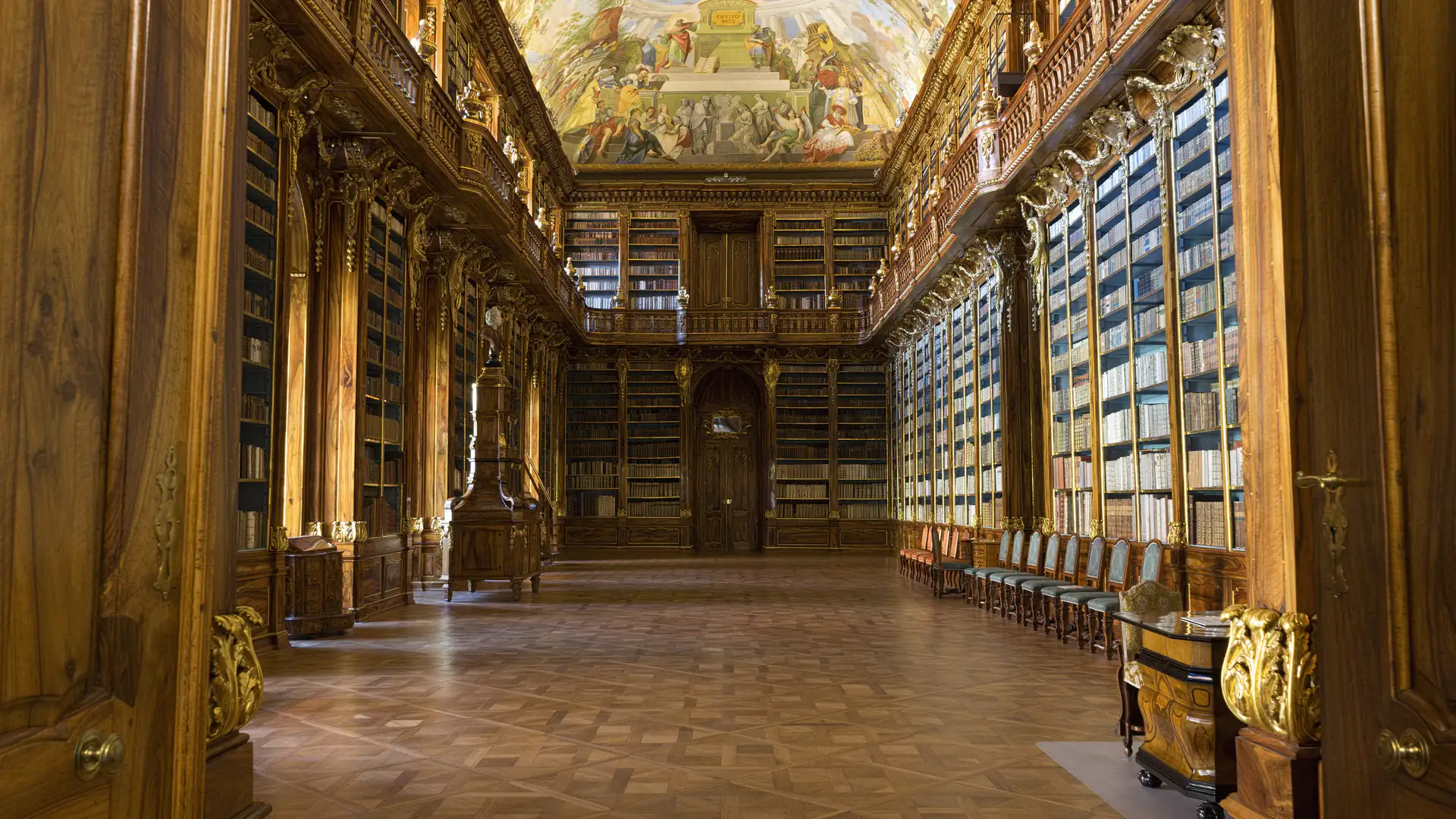
The result, the Theological Hall, holds around 18,000 volumes on theology and scripture behind gilded stucco frames — the core subject matter you'd expect of a Premonstratensian community whose daily life centred on prayer, scripture and pastoral study. The hall's decoration wasn't finished all at once: the ceiling frescoes that now dominate the room were added decades later, in the 1720s, and painted not by an outside master but by Siard Nosecký, a monk of the abbey itself, on the theme of true wisdom. That detail — a member of the community painting its own ceiling rather than commissioning a famous outside name — says something about Strahov's character, more workshop than showcase in its early Baroque decades.
The two 17th-century Dutch celestial and terrestrial globes that still stand at either end of the hall likely arrived around this period too, part of the wider rebuilding of the abbey's intellectual apparatus after 1648. Together, the hall, its frescoes and its globes represent roughly half a century of steady recovery — proof that Hirnheim's project succeeded, even if it took three generations of abbots to see it fully decorated.
1780s: Joseph II's reforms and the Philosophical Hall
A century after Hirnheim's Theological Hall, Strahov needed room again — this time not because of war, but because of politics. In the 1780s, Holy Roman Emperor Joseph II carried out sweeping reforms of religious life across his territories, dissolving monasteries that he judged did not contribute directly to education, healthcare or pastoral care. Among the houses closed was Louka Convent, a Premonstratensian monastery in southern Moravia, whose library and its finely carved walnut bookcases had nowhere to go.
Strahov's abbot at the time, Václav Mayer, arranged for Louka's books and their cases to be brought to Prague rather than dispersed, and commissioned a new hall — later overseen by the architect Ignác Palliardi — built specifically to house them. At 32 metres long, 10 metres wide and 14 metres high, the resulting Philosophical Hall is the larger of Strahov's two halls, its two-storey walnut shelving a transplant from a monastery that no longer exists rather than a design made for the room it now fills.
The hall's ceiling waited until 1794 for its decoration, when the Viennese painter Franz Anton Maulbertsch, already one of the most sought-after fresco painters in Central Europe, took on the commission with a single assistant. Working at speed — the whole ceiling was completed in about six months — Maulbertsch produced The Intellectual Progress of Mankind, a single sweeping composition that moves from Old Testament figures including Moses, Adam, Eve, Cain, Abel and Noah, through Solomon and Socrates, to Alexander the Great and Saint Paul preaching among the ruins of a pagan temple in Athens. It reads as an argument in paint for exactly the kind of learning Joseph II's reforms claimed to prize — knowledge advancing, generation by generation, toward wisdom — installed, not coincidentally, in a room built from the collection of one of the monasteries his reforms had closed.
1950: the communist seizure
The 20th century brought Strahov's library its third rupture, and this time the threat came from the Czechoslovak state itself. On the night of 13–14 April 1950, in a nationwide crackdown remembered as Operation K, the Communist authorities moved to dissolve male religious orders across the country in a single coordinated action. At Strahov, the Premonstratensian community — around 26 canons — was forcibly expelled, and the monastery passed into state hands.
The library itself was not destroyed this time, but it was taken out of the abbey's care. Its books and halls became part of the state's Museum of National Literature, which opened the collection to the public in the mid-1950s under state management rather than the monastery's own. Other parts of the complex were put to unrelated uses in the decades that followed, including a period as army storage — a strange, secular interruption in a story otherwise built around religious community and scholarship.
That arrangement lasted nearly forty years. It wasn't until the fall of communism in 1989 that the process of restitution began, gradually returning confiscated church property, including Strahov's library and monastery buildings, to the Premonstratensian order. Compared with the violent losses of 1420 and 1648, the communist period preserved the physical collection even as it stripped the community of its ownership and purpose — a reminder that a library's survival and its freedom are not always the same question.
1989 onward: restitution and today
Since the restitution of the early 1990s, Strahov has operated once again as a working Premonstratensian abbey, with the library halls, the Cabinet of Curiosities and the Strahov Picture Gallery open to visitors much as they are today. The Museum of National Literature that had run the collection under communism gradually handed responsibility back to the monastery, and conservation work has continued on the frescoes, the globes and the books themselves, many of which are centuries old and require careful, ongoing care rather than a one-time restoration.
What makes Strahov's history unusual isn't any single event — plenty of European libraries survived a war or a political upheaval — but the sheer repetition: burned by the Hussites in 1420, looted by the Swedes in 1648, and seized by the state in 1950, the library at Strahov has effectively been rebuilt from a low point three separate times across six centuries. The Theological Hall and Philosophical Hall that visitors see today are themselves the products of the second and third of those rebuildings, not survivors from the abbey's medieval founding.
That pattern is worth carrying with you into the halls. The gilded stucco, the globes, the walnut cases from Louka and Maulbertsch's fresco all look like continuity — the settled, permanent look of an institution that has simply always been there. In fact, each is the result of a specific abbot, at a specific moment of recovery, choosing to rebuild rather than let the collection stay diminished. Strahov's library is less a single unbroken inheritance than a series of restarts, each one more ambitious than the last.
Today, visiting Strahov means encountering the results of all three rebuildings at once, layered on top of each other in a single short visit. The library exhibition traces the story in outline; the Theological Hall shows the 17th-century recovery in gilded stucco and globes; the Philosophical Hall shows the 18th-century recovery in walnut cases and Maulbertsch's fresco; and the fact that any of it survived the 20th century intact for the community to reclaim after 1989 is itself part of the story worth carrying with you through the doorway of each hall.
Frequently asked
When was Strahov Monastery founded?
In 1143, by Bishop Jindřich Zdík, Bishop John of Prague and Duke Vladislaus II of Bohemia, for canons of the Premonstratensian order.
Has Strahov's library been destroyed before?
Yes, twice, before the 20th century: burned by Hussite forces in 1420, and looted by Swedish troops in 1648, in the final weeks of the Thirty Years' War.
Why are the library halls Baroque rather than medieval?
Because both halls were built after the medieval library was lost — the Theological Hall in the 1670s after the 1648 looting, and the Philosophical Hall in the 1780s to house books from a dissolved sister monastery.
What happened to Strahov under communism?
In April 1950 the state expelled the monastic community and placed the library under a state literary museum; it was returned to the Premonstratensian order after 1989.
Who painted the Philosophical Hall's ceiling, and when?
The Viennese painter Franz Anton Maulbertsch, working with a single assistant, completed The Intellectual Progress of Mankind in about six months in 1794.